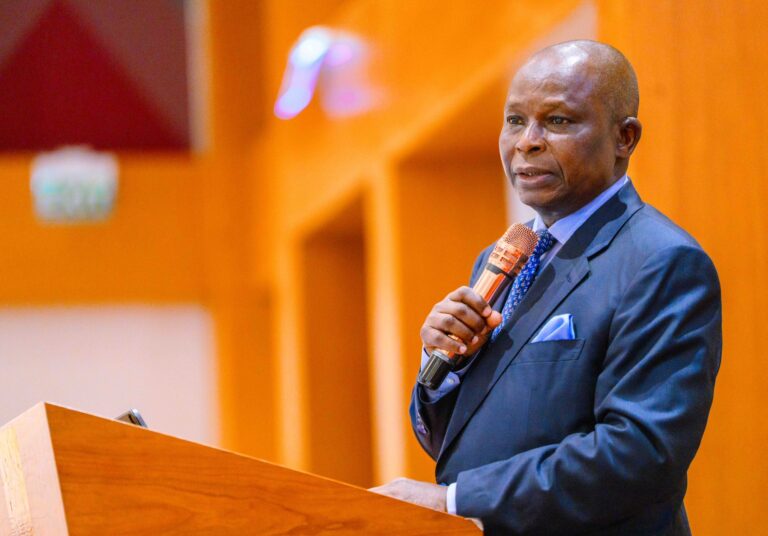

I am pleased to join you at this 18th edition of the Annual Business Luncheon organised by S. P. A. Ajibade & Co. This event has become one of the more stable and thoughtful platforms for engagement within our profession. It is the product of consistent commitment, year after year, by Dr. Babatunde Ajibade, SAN, and the partners of the firm. Their work has provided a forum where the Bar and Bench pause to reflect on the direction of our profession and the justice system.
Since 2008, this luncheon has examined issues that shape legal practice and the administration of justice. Each edition has addressed a concern of its time: the pressures of globalisation on legal practice, the demands it places on legal education, and the challenges of practising law as a business. It has engaged on ethics and integrity, on how lawyers can deepen partnerships, and on the relationship between courts and law enforcement agencies in civil disputes.
In recent years, the luncheon has turned its attention to the regulation of legal practice, the future of lawyering in a technology-driven world, talent retention, data protection, the need or otherwise for a scale of charges for legal services, and transparent elections within the profession. These topics reflect the needs of our profession and the quality of this platform as a space for conversation.
This year’s theme, “Rebuilding Public Trust in the Nigerian Justice System: Responsibilities of the Bar, the Bench, and the Society,” continues that tradition. Public trust in the justice system is central to the existence of the legal profession. Without trust, the system cannot function. Without trust, the public cannot rely on the courts for the protection of rights or the resolution of disputes. Without trust, the work we do loses meaning.
The Nigerian justice system faces pressures. Some are structural. Some stem from gaps in process, capacity and funding. Others are rooted in the behaviour of individuals across the Bar, the Bench and the wider society. Yet, in all of this, one fact remains: trust is built through conduct. Trust is maintained through fairness, efficiency and transparency. Trust is repaired through action.
Across the sector, we are seeing steps aimed at strengthening that trust. Under the leadership of His Excellency, President Bola Ahmed Tinubu, GCFR, the Federal Government has prioritised the strengthening of the justice sector as part of the Renewed Hope Agenda. The rule of law and institutional reform are central to this administration’s vision for national development.
The President sponsored the Judicial Office Holders Salaries and Allowances Bill to the National Assembly, which was passed into law to review the remuneration of judicial officers. This was necessary. Adequate remuneration is one safeguard against compromise and a recognition of the weight of responsibility that judicial officers bear. It also signals that the government understands that an independent and effective judiciary requires investment.
The Federal Ministry of Justice has developed and launched the National Policy on Justice, a framework addressing twenty thematic areas, including access to justice, fair and speedy dispensation of justice, transparency and accountability, alternative dispute resolution, independence of the judiciary, and application of technology in justice administration. The Ministry also launched the Plea Bargain Guidelines to bring structure, transparency and consistency to plea bargain processes in criminal prosecutions.
Under this administration, the Arbitration and Mediation Act was passed to strengthen Nigeria’s framework for alternative dispute resolution, positioning Nigeria as a competitive destination for commercial dispute resolution. The administration has prioritised the reform of correctional services and the decongestion of custodial centres through alternative dispute resolution mechanisms and the review of cases involving awaiting trial persons.
In partnership with the judiciary, the executive has worked to support the deployment of technology in court processes, including the Administration of Criminal Justice Monitoring Portal at the Federal level. When implemented, the portal will allow stakeholders to track arrests, detention and movement of cases through the criminal process from the point of arrest. Some states are now exploring similar portals, drawing from the federal model.
The Chief Justice of Nigeria and heads of court have also taken measures to improve justice delivery and public confidence. One example is the public announcement of proposed judicial appointees and the invitation for public comments on their suitability. This represents a shift toward transparency in appointments.
Another example is the ongoing digitisation of court processes by various courts, including the Borno State High Court, Rivers State High Courts, and the Federal High Court, among others.
These efforts sit within a larger context. It was with awareness of the sector’s challenges that we convened the National Summit on Justice 2024. The summit brought stakeholders together to examine the justice system and agree on reforms. The Communiqué, signed by the Chief Justice of Nigeria, the President of the Nigerian Bar Association, and me, has been shared with all attendees by the organisers. The recommendations are clear and actionable, and steps are being taken towards their implementation.
Before I turn to today’s programme, I must address the survey conducted by S. P. A. Ajibade & Co. ahead of this event. The decision to ground this discussion in data is commendable. Too often, we rely on impressions and anecdotes when we speak about public trust. This survey offers something more rigorous. It provides a basis for identifying the factors that weaken trust and the interventions that might restore it.
The organisers have shared preliminary findings with me. The results will be presented during this event. What stands out is the clarity with which respondents have identified breakdowns in the system: delay, lack of transparency, ethical lapses, and uneven access to justice, among others. These are not new concerns. But seeing them quantified and ranked gives us a sharper picture of where attention must be directed.
The survey also reveals something else: the public still believes that reform is possible. That belief is itself a form of trust. It is a signal that the work we do matters, and that people are willing to engage if we are willing to act. The findings from this survey will inform the work of the Federal Ministry of Justice in the months ahead. I encourage all stakeholders present to treat the results as a call to responsibility.
I commend the organisers for assembling speakers representing different stakeholder groups. Bringing together individuals of this calibre cannot have been easy. With Professor Yemi Osinbajo, SAN, GCON, the immediate past Vice President of Nigeria, delivering the keynote address and the panel comprising Honourable Justice Habeeb Abiru, JSC, Honourable Justice Oludotun Adefope-Okojie (Rtd), Professor Pat Utomi, Dr. Charles Adeogun-Philips, SAN, and Mr. Hakeem Belo-Osagie, reflecting a combination of voices from the executive, the judiciary, the Bar, the business community and civil society, one is assured that today’s discussion will reflect the full range of perspectives necessary for addressing public trust.
I thank Professor Osinbajo and each of the panellists for agreeing to speak on this issue. Your presence here today reflects a shared commitment to the restoration of public confidence in our justice system. We are fortunate to have your voices at this table, and we look forward to your contributions.
As we discuss today’s theme, the focus must remain on responsibility. The Bar has a duty to uphold ethics and professional conduct. The Bench must reinforce fairness, openness and case management. Society must also play its part by engaging constructively with the system and supporting the rule of law.
I commend S. P. A. Ajibade & Co. for sustaining this platform. I acknowledge the contributions of Dr. Ajibade, SAN, whose work has supported legal development, professional dialogue and justice-sector reform over the years. I look forward to the discussions ahead.
Thank you, and God bless the Federal Republic of Nigeria.