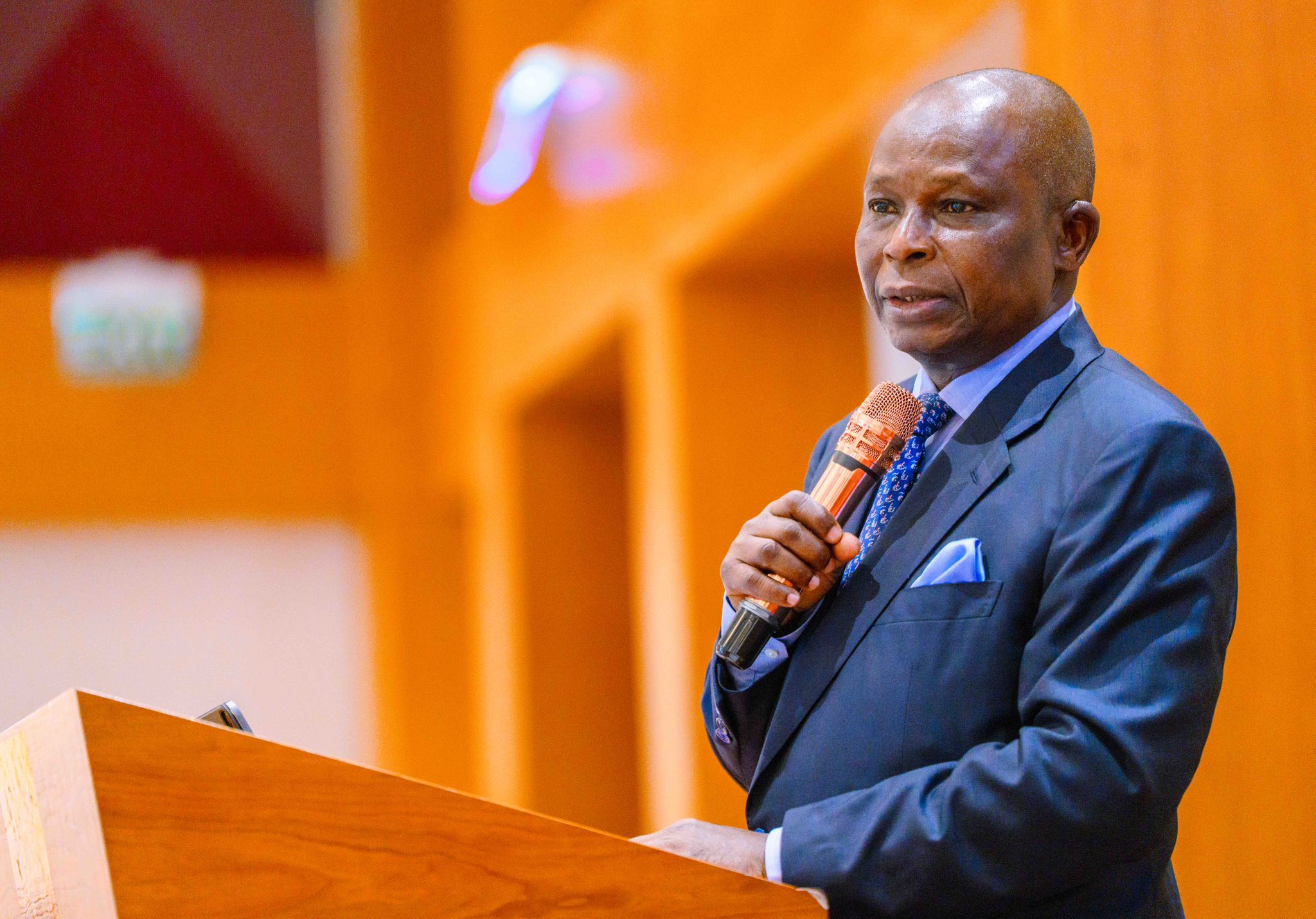
It is my pleasure to welcome you all to this retreat organized for the top management of the Federal Ministry of Justice. The purpose of this retreat is to reflect, realign, and synergize our collective goal of enhancing the administration of justice in Nigeria, with particular emphasis on leveraging technological tools to strengthen our processes and improve service delivery.
Let me begin by expressing my profound gratitude to His Excellency, Governor Umo Eno of Akwa Ibom State, for his generous support towards hosting this retreat. We are deeply appreciative for the excellent facilities and logistical support which Your Excellency has provide to the Ministry. Your gracious support and presence today reflect your steadfast commitment to measures that advance the administration of justice in Nigeria.
I must also acknowledge the remarkable developmental strides being recorded in Akwa Ibom State under Your Excellency’s leadership. From innovative governance initiatives to far-reaching reforms—including the implementation of a higher minimum wage and additional benefits for encourage civil servants—your achievements are commendable. I salute you, sir, for your visionary leadership and commitment to social and economic progress.
I wish further to appreciate the management and staff of the Ministry for their commitment and ingenuity in discharging their responsibilities despite prevailing challenges and limited resources. I am encouraged by the recent administrative improvements within the Ministry, particularly the adoption of technological tools such as the Performance Management System (PMS), and the ongoing transition from manual data management to the Enterprise Content Management (ECM) system. I especially commend the Solicitor-General and Permanent Secretary for her steadfast dedication to ensuring that the Ministry embraces the service-wide technological transformation policy of this administration.
The Federal Ministry of Justice is continuously developing strategies to align with the Renewed Hope Agenda of His Excellency, President Bola Ahmed Tinubu, GCFR. It is within this context that we have deemed it essential to convene this retreat, away from our daily routines, to allow for sober reflection on our progress, challenges, and future objectives for enhanced justice delivery.
Ladies and Gentlemen, we live in a technologically driven global village, characterized by complex challenges, heightened public expectations, and evolving threats. This retreat must therefore serve as a strategic platform for evaluating our institutional position, defining our direction, and mapping out the steps required to achieve our objectives. Experience has shown that adoption of ICT significantly unlocks transformative potential for sustainable development in Nigeria.
As you are well aware, the justice sector is one of the catalysts for national development. There can be no sustainable growth without access to justice, respect for the rule of law, and a strengthened justice system. The criminal justice sector, in particular, faces daunting challenges: inadequate access to justice, overcrowded correctional facilities, delays in trials, and other systemic inefficiencies. These issues require urgent and technology-driven solutions.
Furthermore, with the increasing reliance of citizens on technology to access services, the Ministry can no longer depend solely on traditional modes of communication or manual processes. If we are to meet the expectations of Nigerians and support the President’s vision for justice sector reforms, we must embrace digital tools that guarantee timely and efficient service delivery.
The Ministry must therefore take the lead in adopting technology to enhance justice delivery. The challenges of today demand that justice never sleeps. With growing legal demands and societal pressures, we must adopt innovative strategies to keep the wheels of justice continuously in motion.
Distinguished colleagues and State Counsel, the success of our collective mandate depends on your ability to lead decisively, inspire your teams, and overcome institutional inertia. As the principal legal institution of the Federal Government, the Ministry of Justice must consistently position itself not only as a bastion of legal excellence but also as a model of innovation, accountability, and effective public service delivery.
I therefore charge all Departments, Units, and Directorates to align their priorities with the Federal Civil Service Strategy and Implementation Plan 2021–2025 (FCSSIP25), the National Policy on Justice, and the Renewed Hope Agenda. These frameworks all underscore the centrality of technology in service delivery. Our task must go beyond compliance; it must embody proactive leadership in implementation, characterized by digital transformation, agile governance, strategic foresight, and data-driven decision-making.
I encourage you to approach this retreat with the same zeal and commitment to excellence for which the Ministry of Justice is known. I expect to see well-articulated commitments, practical implementation timelines, and clear ownership of outcomes. The ultimate objective is to improve our systems and processes by accelerating ECM deployment, integrating AI-enabled legal tools, and streamlining legal workflows for greater socio-economic impact.
Let me also take this opportunity to assure you of my personal commitment to the welfare and professional growth of all staff of the Federal Ministry of Justice. Beyond the reforms we pursue institutionally, I recognize that our people remain our greatest asset. Accordingly, deliberate measures will be taken to continuously improve the work environment, provide the necessary tools and resources to enhance efficiency, and promote a healthy work-life balance. It is my firm belief that a motivated, well-supported, and adequately equipped workforce is indispensable to the effective delivery of justice and the realization of our shared mandate.
I would also like to express profound gratitude to Professor Koyinsola Ajayi, SAN, of Olaniwun Ajayi & Co., for the generous donation of seventy-five (75) laptops to the Ministry in support of our digitalization efforts. This act of generosity is more than an investment in technology; it is an expression of confidence in the Ministry’s resolve to pursue reform and modernization. I assure you, Professor, that this confidence will not be misplaced. These resources will be deployed strategically to strengthen efficiency, accountability, and service delivery in the justice sector.
Permit me also to specially acknowledge the AIG Foundation and the RoLAC Programme for their invaluable contributions to our reform journey. Through technical assistance, strategic engagement, and targeted support, you have consistently demonstrated what true partnership looks like. Your respective investments in public and justice sector reform have greatly enhanced our ability to deliver on our mandate. We do not take these partnerships for granted, and we remain committed to sustaining and expanding these collaboration for greater national impact.
Once again, I thank His Excellency, Governor Umo Eno, for graciously hosting this retreat and for honouring us with his presence today despite his demanding schedule. Your Excellency, your support and partnership mean a great deal to the Ministry and indeed to the advancement of justice in Nigeria.
I thank you all for your presence and for your anticipated contributions to the success of this retreat. I wish you fruitful deliberations and impactful outcomes. Thank you.